Start With a Groove.
Finish the Record.
Sound is Avlory's music studio. It opens simply and grows into a full studio, with Avlory's own instruments and effects, 18 templates that set a song up the way each style is made, a mixer where what you hear is exactly what you export, and release details that go straight to Waverate and DistroKid. Every clip on this page is real audio rendered by Sound's engine, and nothing plays until you press play. The screens are from Sound's browser test build, and every number says how it was measured.
- Windows
- Linux
- macOS
- iOS
- Android
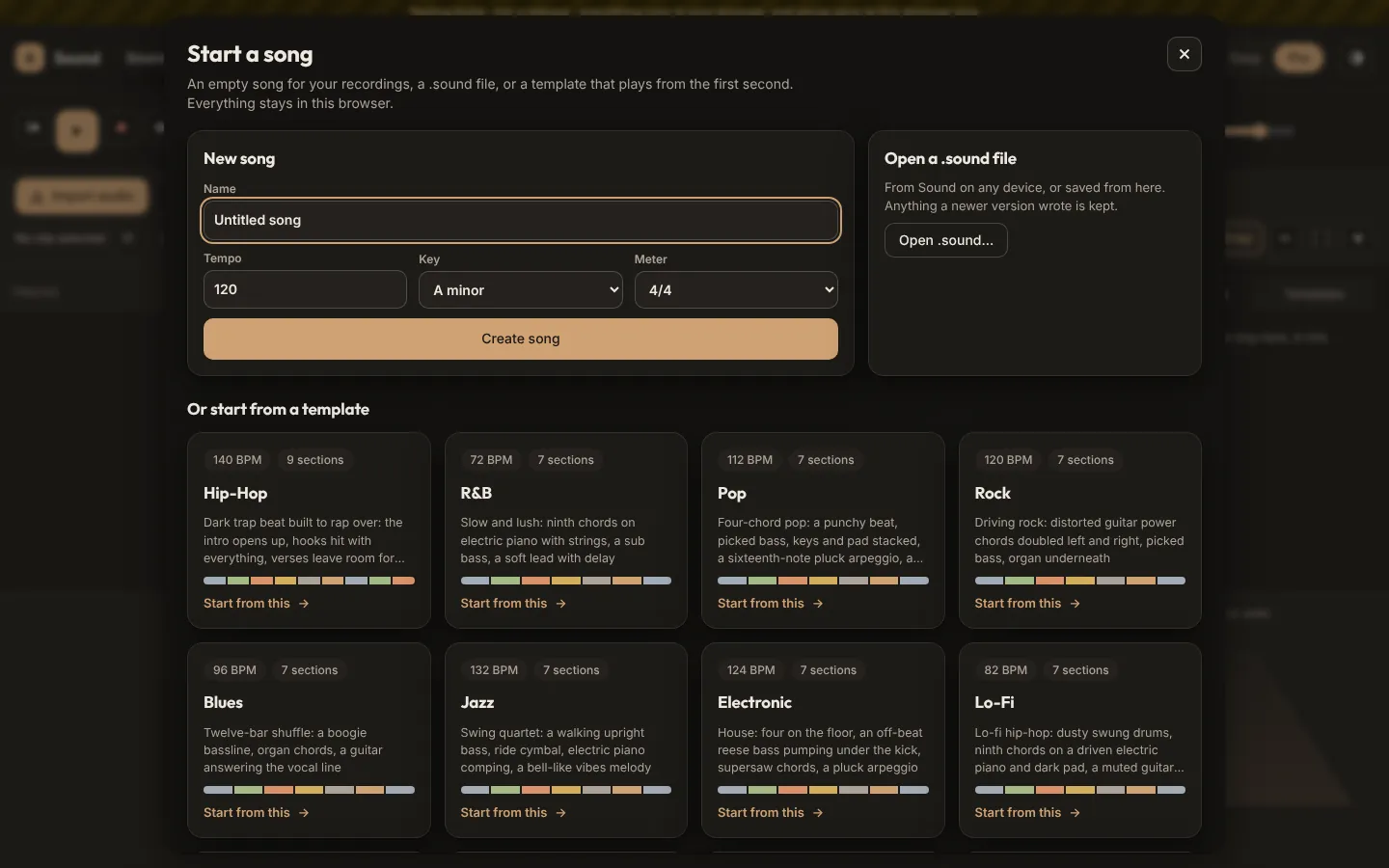
A template is a song, not a loop.
Each template sets the tempo, swing, key, sections with fills, builds and drops, and a mix to start from. There are 12 genres, 4 fusions (hip-hop × gospel, hip-hop × classical, jazz × blues and R&B × jazz) and two showcase pieces. A template opens as an ordinary song made with Sound's own tools, so you can change anything in it. Below are four of them as Sound renders them, opened and exported with nothing changed.
How every clip on this page was made: Sound's desktop engine (version 0.1.0, the library the app loads, on the same calls the app makes) opened the template, made the edit the caption names, and rendered the whole song offline to 24-bit WAV at 48 kHz on 4 November 2026, on Linux, with Sound's recorded instrument packs installed. The excerpt was cut on the bar, faded out over half a second and encoded for the web as Opus at 40 kbit/s and AAC at 64 kbit/s. Nothing else was done to the sound. avlory/apps/avlory_web/tools/render-sound-demos.py
Measured 27 and 28 October 2026 on a shared cloud VM with 4 vCPUs (Intel Xeon, 2.10 GHz), Linux, release builds, no sound card (a timed stand-in plays the speakers' part). Another job was compiling on the same machine, so means are the reliable figures. cargo test --release -p avlory-audio-lab --test engine_bench -- --ignored --nocapture --test-threads=1
| Recorded library | Licence | What Sound plays from it |
|---|---|---|
| Salamander Grand Piano V3 | CC BY 3.0 | The grand piano, credited in the app |
| VSCO 2 Community Edition | CC0 | Strings, brass, woodwinds, harp, organ, mallets |
| Versilian Community Sample Library | CC0 | Hand percussion, vibraphone, kalimba, tenor sax, harmonica |
| Virtuosity Drums | CC0 | A recorded acoustic drum kit |
| Karoryfer basses and guitars | CC0 | Electric and upright bass, electric guitar |
| Avlory's own synths | Avlory's own | 808s and genre kits, electric piano, pads, leads, the choir |
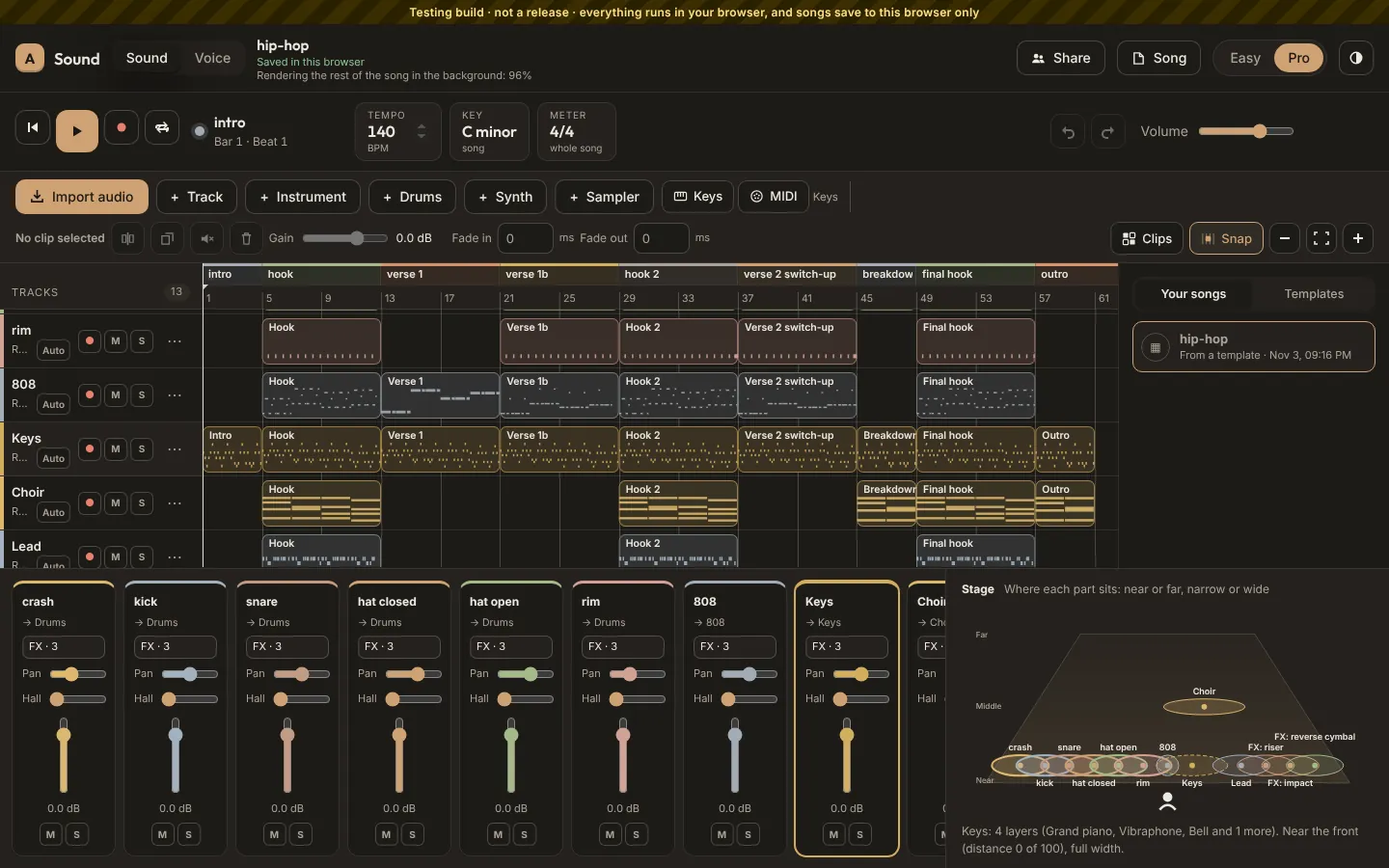
A mixer with room to spare.
Volume, pan, mute and solo, sends to shared reverb and delay, any of 17 effects on any track, bus or the master, and meters everywhere. A track can stack up to 32 instruments into one sound. Faders glide instead of clicking, and changing a track's effects while the song plays hands over in 30 ms: the old chain keeps running and fades out under the new one. Hear one part three ways: as the template sets it, with an effect added, and pushed to the back of the room.
The three clips are as the engine rendered them, within about 1 dB of each other in level. Switching keeps your place in the bar.
Measured 27 October 2026 on the same 4-vCPU VM with no sound card, mean load at 48 kHz; before and after were run back to back from saved builds. Real computers and audio interfaces are still to be measured. cargo test --release -p avlory-audio-mix --test engine_bench -- --ignored --nocapture --test-threads=1
Everything a template does, you can do.
Templates are built from the same instruments, effects and controls you get, so nothing in them is out of reach. Sound has 47 recorded instruments, 18 synths and 12 drum kits of its own, a synth you program, a sampler that chops and warps, 17 effects, and tools other studios don't have: stacks of up to 32 instruments that fuse into one sound, and one Distance control for depth. Hear three of them.
Recorded instruments
First build47 instruments from 52 packs: grand piano, a string section with sustained, pizzicato, spiccato and tremolo, brass, woodwinds, basses, guitar, a recorded kit, percussion and mallets. A 117 MB core set installs with the app; the rest download when first picked and stay offline.
Synths you program
First buildStart from any of 18 presets: up to four oscillators (FM, a plucked string, wavetables built in or loaded from a WAV), unison of seven, a filter with its own envelope, drive and four LFOs, free or in time. A key played live is the very note the song renders.
Drum rack and Drum Synth
First build16 pads, each with layered sounds, pitch, decay, choke groups, a hall send and its own effects, and a step sequencer. The 12 genre kits (88 sounds) come from the Drum Synth, so they're original by construction.
A sampler that chops
First buildAny recording becomes an instrument: start, end and loop with a crossfade, the root note found by listening, an envelope and filter. Chop by hits, a grid or the beat onto pads, across the keys or onto the timeline; warp it to the song's tempo with its pitch kept.
Stacks that fuse
First buildUp to 32 instruments on one track, each with its own octave, level, pan, detune, timing, tone, swell, grit, drift and glide (the 808 slide), plus a selector that thins a stack in the verse and opens it in the hook.
Depth with one control
First buildDistance darkens a part and sends it further into the shared hall at once; every part shares a small room; width keeps the low end in the middle. Distance can move over the song.
17 effects
First buildEQ, compressor, reverb, plate, delay, chorus, saturation, limiter (true peak), multiband, filter, width, transients, doubler, lo-fi, gain, tape stop and stutter, plus ducking under the kick. Each shows its latency and how long its tail rings.
Knobs and Explain this sound
First buildUp to eight knobs a track (Warmth, Width, Punch, Space…), each moving several settings at once and automatable, and a plain-words explanation of how any part is made.
Clip grid
First buildScenes and slots beside the timeline, launched on the bar, with follow actions, trigger, gate and toggle, pads that launch slots, and the performance recorded into the arrangement.
Play and record
First buildMIDI keyboards (MPE too), the computer's keys or the on-screen keyboard play any track live, 64 voices. Record several tracks at once, punch in and out, loop takes and comp them. A take survives a crash.
Piano roll and automation
First buildChords from the key, strum, arpeggiate, fold, legato, move into the scale, quantise with swing, humanise with a seed. Lanes with curves and LFOs on any setting, exported exactly as heard.
Your own instruments and voice
First buildSing or play notes one by one and they become an instrument kept in the song, each note tuned to its pitch. The vocal range finder names your range and voice type, and a voice can be reshaped into another range (in the engine; the app's screen comes later).
More effects
PlannedGate, de-esser, dynamic EQ, convolution reverb, phaser, flanger, auto-pan, vocoder and an analyser; sidechain keying for any dynamics effect.
Stem separation, with a rights check
PlannedSplit a recording on your device, keep the original, and know whether a split from someone else's record can be released, using the sample library's fingerprinting.
Session players
PlannedPlayers that follow your chords, drum and melody helpers: on your device, off by default, easy to turn on and off.
Scoring
PlannedA Create timeline in as a video track with its markers, the mix sent back; layered music Nebula mixes by intensity.
Other makers' plug-ins, kept apart.
Sound's first build plays only Avlory's own instruments and effects, so a song needs nothing else installed. Plug-ins from other makers come in the second build of the desktop app: they'll load because studios rely on them, but Sound doesn't feature them. Each will run in a separate process, so a plug-in that crashes can't take the song with it. The plan for phones, still a proposal, is Avlory's own only: iOS has AUv3, but Android has no common plug-in format.
| Platform | Formats | Status |
|---|---|---|
| Windows | VST3, CLAP | Second build |
| macOS | VST3, CLAP, Audio Units | Second build |
| Linux | VST3, CLAP | Second build |
| iOS | AUv3 is the format there. Proposed: phones use only Avlory's own instruments and effects | Proposed |
| Android | No common plug-in format; Avlory's own instruments and effects only | Phone app planned |
| Browser test build | Avlory's own only | Testers |
Avlory's own, everywhere
First buildInstruments and effects written in Rust on the shared audio core, so they run the same on every platform and the same in the browser build.
Sandboxed, crash-proof
Second buildEach plug-in outside the engine, in its own process. Proposed: a crash shows a reload button on that device while the song keeps playing, and a meter shows each plug-in's CPU and memory.
A scan that never blocks
PlannedPlug-ins are found in the background, never holding up start-up, with a manager to turn them on, hide them and sort them.
Sound's instruments in other studios
PlannedAvlory's instruments and effects as VST3, AU and CLAP plug-ins for other DAWs, and AAX for Pro Tools, so producers can try them before they switch.
ASIO on Windows
LaterBuilt into the engine and switched off until Steinberg's licence agreement is signed. Not a plug-in format, but what Windows studios expect from their audio interface.
What goes in, what comes out.
The desktop app is built on Linux first; Windows and macOS run the same engine code, which compiles for Windows but hasn't been built and run on either yet. The browser build is for testers and reads audio through the browser's own decoder. The phone apps come in phase 3.
| File | What Sound does with it | Linux | Windows | macOS | Web | iOS | Android |
|---|---|---|---|---|---|---|---|
| Reads | |||||||
| .sound | Opens a song. Older versions open newer songs and keep what they don't understand | First build | Not run yet | Not run yet | Test build | Planned | Planned |
| .voice | A Voice recording dropped in as a track, copied in with a link back | First build | Not run yet | Not run yet | Not supported | Planned | Planned |
| WAV | Audio onto a track, or into the sampler | First build | Not run yet | Not run yet | Test build | Planned | Planned |
| FLAC | Into the sampler on desktop; onto a track in the browser | First build | Not run yet | Not run yet | Test build | Planned | Planned |
| MP3, OGG, Opus, AAC | Audio onto a track, decoded by the browser | Not supported | Not supported | Not supported | Test build | Not supported | Not supported |
| MIDI files | Standard MIDI, type 0 or 1: each part a track with its tempo, channel 10 a drum rack | First build | Not run yet | Not run yet | Not supported | Planned | Planned |
| .soundrack | A rack preset with the recordings its samplers play | First build | Not run yet | Not run yet | Test build | Planned | Planned |
| SFZ instruments | A sample library you own becomes an instrument inside the song (in the engine; no screen in the app yet) | First build | Not run yet | Not run yet | Not supported | Planned | Planned |
| JPG, PNG | Cover art, checked for the stores | First build | Not run yet | Not run yet | Not supported | Planned | Planned |
| Stems, DAWproject, other DAWs' projects | A folder of stems in one step, the open exchange format, and Live, FL and Logic projects | Planned | |||||
| AAF, OMF, MusicXML, video | For scoring outside Create, and notation | Planned, phase 3 | |||||
| Writes | |||||||
| .sound | Saved atomically, every edit journalled first, so a crash loses nothing | First build | Not run yet | Not run yet | Test build | Planned | Planned |
| WAV | The mix; on desktop 16 or 24-bit at 44.1 or 48 kHz, with the ISRC and credits embedded | First build | Not run yet | Not run yet | Test build | Planned | Planned |
| FLAC | The mix, 16 or 24-bit, tagged | First build | Not run yet | Not run yet | Not supported | Planned | Planned |
| MP3 | 320 kbit/s through LAME, a separate library beside the app; without it, Sound says how to get it | First build | Not run yet | Not run yet | Not supported | Planned | Planned |
| Stems | WAV or FLAC, by track or by bus, from one pass of the mixer | First build | Not run yet | Not run yet | Not supported | Planned | Planned |
| MIDI files | A clip, a track or the whole song, with the tempo map | First build | Not run yet | Not run yet | Not supported | Planned | Planned |
| .soundrack | A rack preset to share, recordings included | First build | Not run yet | Not run yet | Test build | Planned | Planned |
| Release packages | Waverate directly; for DistroKid, audio, cover, release.json and the upload checklist, as a folder or ZIP | First build | Not run yet | Not run yet | Not supported | Planned | Planned |
| AAC, Opus, a preview inside .sound | Smaller files, and a preview any Avlory app plays without the editor | Planned | |||||
| Game and spatial audio | Layers for Nebula, Wwise and FMOD; Dolby Atmos and ADM later | Planned | |||||
From the engine's code: crates/sound (the app's calls), crates/project (.sound and MIDI files), crates/release (WAV, FLAC and the packages), crates/lame (MP3), crates/lab (FLAC and SFZ), the desktop app's file pickers, and the browser build's importer. “Not run yet” means the same code, compiled for Windows but not yet built and run on Windows or macOS.
What you hear is what you export.
An export runs the same mixing graph as playback, offline and faster than real time, so the file holds exactly the samples you heard. That's tested bit for bit at buffer sizes from 16 to 4,096, at random sizes, on 1 to 8 threads, and on every template. Stems come from one pass and add up to the mix before the master's effects. Here are three stems from one export of the Hip-hop hook, beside the mix.
Stems leave the master's effects off, so they sit quieter than the mix. Switching keeps your place in the bar.
Measured 27 October 2026 on the same 4-vCPU VM: a 60-second song, offline. The bit-for-bit checks run with every cargo test in crates/mix/tests/engine_bench.rs; the speeds come from cargo test --release -p avlory-audio-mix --test engine_bench -- --ignored --nocapture --test-threads=1
Release with every credit attached.
Release details live in the .sound project: credits with roles, splits, the ISRC, UPC and ISWC, and the ℗ and © lines. Sound sends a release straight to Waverate, and makes a ready-to-upload package for DistroKid (it has no public API) with a checklist of its upload form, in order. One recording keeps one ISRC forever, on every service. Check a code the way Sound does.
Two letters, three letters or digits, a two-digit year and five digits. Hyphens and spaces are fine.
Examples This release isWaverate, directly
BuiltSent through Waverate's artist service with your sign-in, splits and credits filled in. The engine never sees your sign-in token.
DistroKid, as a package
BuiltAudio, cover, release.json and the upload form's checklist with copy buttons, until the planned partnership gives a direct link.
Codes inside the file
BuiltWAV (16 and 24-bit) and FLAC at 44.1 or 48 kHz, with the ISRC embedded (ID3 in WAV and MP3, Vorbis in FLAC), a loudness report and cover checks.
A number never reused
BuiltOnce Avlory has its registrant code, Sound issues codes from a registry that never hands out a number twice, even after a deletion.
Samples with terms you can negotiate.
A shared library of original sounds only: every upload is checked against known recordings first. Each sample shows its terms. The artist who made it sets the rate, from 0% (credit only) up, and you can send a counteroffer, which they don't have to accept. On Waverate the agreed rate pays real money, out of the song's artist royalties, and the sampled artist can cash it out. Try an offer on an example sample.
An example sample by an example artist: 4 bars, D minor, 82 BPM. Free to use while you write; an agreement is needed only to release.
This example artist accepts 12% or more on their own; anything lower they decline and keep their rate. Letting artists set a rate they accept automatically is proposed, not decided.
Original sounds only
PlannedEvery upload is fingerprinted against known recordings, so nobody can sell someone else's sample.
Stamped into the song
PlannedThe fingerprint, both Avlory IDs, the rate, the credit and the date, signed by both, saved in the project and carried into every export.
Other services
Open questionGetting songs onto Spotify and Apple Music goes through a planned DistroKid partnership. How a sample split carries over there isn't decided yet.
Edit one song at the same time.
Everyone edits the same song and sees each other's edits as they happen, like a shared document. When two people move the same control at once, the later move wins and the other stays one click away in history. When two people change the same clip, both versions are kept. You can lock the song, a track or a section; locks expire, and the song's owner can break one, with a notice. Try it with Maya.
Maya is an example collaborator; everything here stays on this page.
Sealed rooms
Testing relayThe song, every edit and every recording are encrypted with a key that's only in the link, so the testing server keeps only scrambled bytes.
Recordings that keep up
Testing relayRecordings go up in chunks in the background. A cut-off upload sends only what's missing, and arrives bit for bit.
Browser and desktop
Testing relayA desktop and a browser join the same room either way round, with per-person undo and who's here.
Invited Avlory IDs
PlannedEditing and recording need an Avlory ID the owner invited. Listening and commenting can use a private link.
Sound and the rest of Avlory.
Sound shares Voice's audio core and sends finished songs on to the rest of Avlory.
Voice
In a first buildOne shared audio core: a Voice recording drops into a Sound song as a track, copied in with a link back.
Waverate
In a first buildRelease straight to Waverate with credits, ISRCs and splits filled in, through Waverate's artist service.
DistroKid
In a first buildA ready-to-upload package (audio, cover, release.json and the upload form's checklist) until the planned partnership gives a direct link.
UpNext
PlannedArtists who release on Waverate are promoted on UpNext as verified artists.
PennySphere
PlannedEarnings from Waverate and Engine purchases in one place.
Create
PlannedMusic in a Create video opens in Sound, and the mix goes back to the timeline.
Sculpt
PlannedAnimation timed to Sound's tempo map, on the beat.
Nebula
PlannedMusic for games, in layers the game mixes by intensity.
Sprout
PlannedSong versions shown as changed regions on a waveform.
Marketplace
Coming soonPublish beats, stems, sample packs, instruments and presets made in Sound: free, paid or with a royalty split.
Where Sound is today.
In development. The mixing engine, the .sound file, the instruments and effects, recording, the 18 templates and release export are built, with a desktop app on Linux first and a browser build for testers. Stems, MIDI files and MP3 export are in the desktop app. The sample library and royalties, plug-ins from other makers (in a separate process, in the second build) and the phone apps come next. Downloads open through the waitlist.
Tested
- On a Linux build machine with 4 processor threads and no sound card.
- The engine's Rust tests, a fuzz test of up to 60,000 random engine calls on every thread, and a monkey test driving the real engine through the app.
- Widget tests on every screen in light and dark, at 200% text and with reduced motion; the browser build in headless Chromium at desktop and phone sizes.
Not tested yet
- Latency on real computers, sound cards and MIDI keyboards (the build machine has none).
- Building and running on Windows and macOS.
- Phones, plug-ins from other makers, the sample library and royalties: not built yet.
No feature moves up a tier
A saved project always opens and exports, even after a plan ends.
Never locked out offline
A failed licence check never stops editing or export.
AI never changes work silently
Every AI change is a visible, undoable suggestion in the AI ledger.
Free to start
Plans and prices are announced at launch. All the promises
Try Sound First.
Sound's downloads open through the waitlist. We'll email you when it's ready on your platform.